
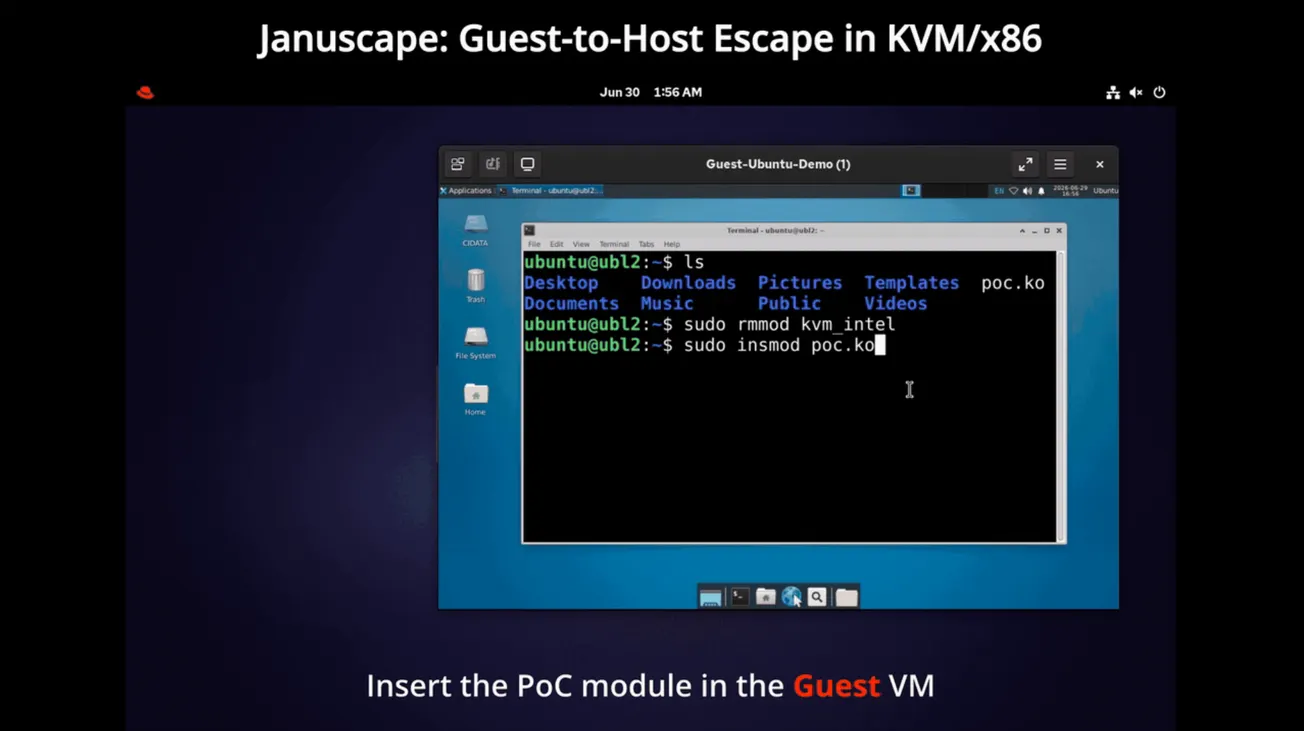
A Long-Lived KVM Bug Resurfaces: Shadow Paging Use-After-Free in the Linux Kernel (CVE-2026-53359)
Vulnerability Overview
CVE-2026-53359 is a use-after-free in the Linux kernel's KVM x86 shadow paging code. It is the second half of a bug that was only partially closed by an earlier fix: a mismatch in the KVM MMU's bookkeeping lets the kernel free a page-table tracking structure while references to it remain live, opening the door to memory corruption in the host kernel. Per LWN, the flawed code path has existed since the 2.6.36 kernel (2010), so it has been dormant across roughly a decade and a half of releases. It carries no CVSS score at the time of writing, and there is no known exploitation. It was resolved in the July 2026 round of stable kernel updates.
This is a host-side memory-safety bug in KVM's shadow MMU, not a remote or web-facing flaw. If you run KVM hosts, apply your distribution's July 2026 kernel update. Systems using hardware-assisted paging (EPT/NPT) exercise the shadow MMU far less, but the correct response is still to patch.
Background: Shadow Paging and the KVM MMU
When KVM cannot lean on hardware-assisted nested paging (Intel EPT or AMD NPT), it falls back to shadow paging: the hypervisor maintains its own shadow page tables that translate guest-physical to host-physical addresses, mirroring the guest's own page tables. KVM tracks each shadow page with a struct kvm_mmu_page, and each shadow page-table entry (SPTE) is reverse-mapped so the kernel can find and tear down mappings later. Two attributes on that structure matter here: the guest frame number (GFN) it represents, and its role, which includes a direct flag distinguishing a directly-mapped large page from a shadowed page-table level. Correct cleanup depends on these fields accurately identifying the structure that owns a given entry.
Technical Analysis
An earlier fix, commit 0cb2af2ea66ad ("KVM: x86: Fix shadow paging use-after-free due to unexpected GFN"), addressed one version of this problem. That bug could be triggered by modifying a page-directory entry (PDE) mapping from outside the guest and then deleting a memslot: the rmap_remove() cleanup would miss entries created after the PDE change, because the GFN of the leaf SPTE no longer matched the GFN recorded on the owning kvm_mmu_page. Entries that should have been removed were left behind, referencing a structure that could then be freed.
CVE-2026-53359 is the hole that fix did not cover. When the modified PDE points to a non-leaf page rather than a leaf, the GFN can be made to match, so the earlier GFN-based check passes. The role, however, does not match: the original large 2MB mapping created a kvm_mmu_page with direct=1, while the new 4KB mapping requires one with direct=0. Because identity was being validated on the GFN alone, the mismatched role slips through, cleanup again fails to account for the right entries, and the kernel can free a kvm_mmu_page that is still referenced. The result is a classic use-after-free: subsequent access to the dangling structure operates on freed memory, which is the foundation for host kernel memory corruption and, in the worst case, privilege escalation on the host. The fix tightens the check so that both GFN and role must agree before entries are treated as belonging to the same shadow page.
Who Is Actually Exposed?
Context matters for prioritization here. The bug lives specifically in the shadow paging path, which modern deployments exercise much less often because current Intel and AMD processors provide hardware nested paging (EPT/NPT) that KVM uses by default. Shadow paging still comes into play in scenarios such as older hardware, certain nested-virtualization configurations, or setups where hardware paging is unavailable or disabled. Triggering the flaw also requires a fairly specific sequence involving a PDE modification and memslot deletion, operations tied to how the virtual machine and its memory are managed, so this is not a trivial one-shot from an unprivileged guest in every configuration. None of that makes it safe to ignore: use-after-free bugs in the host kernel MMU are exactly the class of issue that skilled attackers turn into guest-to-host escapes or local privilege escalation given the right conditions.
Affected & Fixed Versions
| Kernel | Status | Notes |
|---|---|---|
| 2.6.36 through pre-fix releases | Vulnerable | Flawed shadow-paging cleanup path present |
| 7.1.3, 6.18.38, 6.12.95, 6.6.144, 6.1.177 (and mainline) | Fixed | July 2026 stable updates add the role check |
Distributions ship their own kernel builds and backports, so the exact fixed package version depends on your vendor. Track the fix through your distribution rather than the upstream number alone.
Remediation
Guidance for a kernel memory-safety fix like this is straightforward:
- Update the kernel. Apply your distribution's patched kernel from the July 2026 stable series (or a later release that includes the fix), then reboot into it. This is the complete remediation.
- Prefer hardware nested paging. Where practical, ensure hosts use EPT/NPT rather than shadow paging, which minimizes exposure to this code path. Treat this as defense in depth, not a substitute for patching.
- Restrict who can run untrusted guests. On multi-tenant KVM hosts, limit the ability to launch untrusted or attacker-influenced VMs until the patched kernel is deployed, since guest-to-host memory-safety bugs are most dangerous in shared environments.
- Track the fix per distribution. Confirm remediation against your vendor's security tracker, because backported fixes will not match upstream version numbers.
The Bigger Picture
CVE-2026-53359 is a tidy illustration of two recurring themes in kernel security. First, incomplete fixes: the original patch correctly closed the GFN mismatch but left a structurally identical hole reachable through a slightly different path, a reminder that a fix guarding one field (GFN) is not enough when identity actually depends on several (GFN and role). Second, longevity: a defect can sit quietly in a complex, security-critical subsystem like the KVM MMU for well over a decade before the exact triggering conditions are analyzed and reported. The practical takeaway is unglamorous and reliable: keep hosts on current stable kernels, prefer hardware features that shrink the attack surface, and treat the hypervisor's memory-management code as the high-value target it is.




)