World Monitor: A Free, Open-Source Global Intelligence Dashboard with 25 Data Layers and AI-Powered Threat Classification
A real-time situational awareness platform that aggregates 100+ news feeds, military flight tracking, naval vessel monitoring, satellite fire detection, conflict zone mapping, and infrastructure data into a single interactive map with AI-synthesized intelligence briefs. Think Palantir, but open source and free.
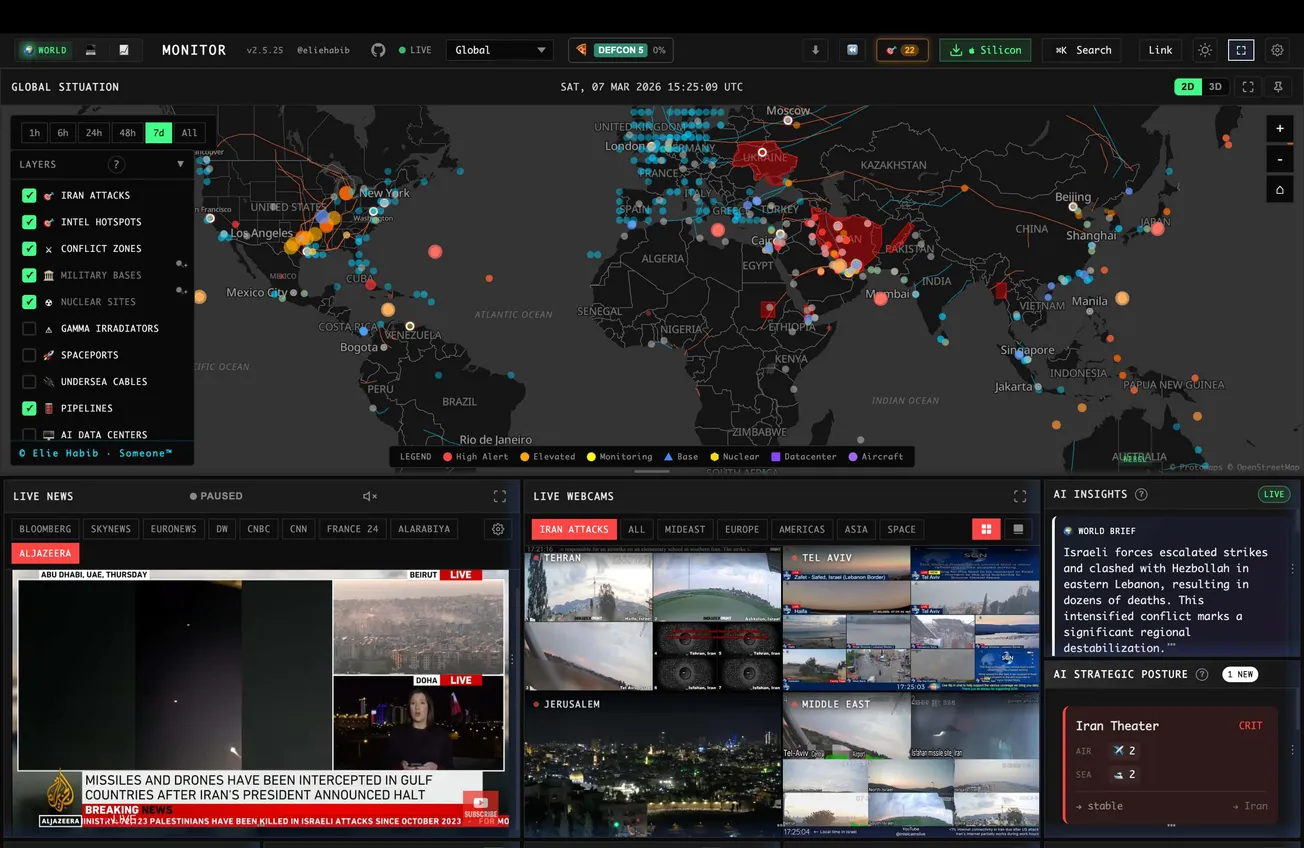
Real-time global intelligence dashboard — AI-powered news aggregation, geopolitical monitoring, and infrastructure tracking in a unified situational awareness interface
OSINT tools that provide real-time geopolitical situational awareness have traditionally been either expensive commercial products or cobbled-together collections of individual data sources. World Monitor, by Elie Habib, is an open-source attempt to build a unified intelligence dashboard that aggregates military tracking, conflict monitoring, infrastructure mapping, news correlation, and AI-powered analysis into a single browser-based interface — and it's free.
With 41.1k stars, it's one of the fastest-growing OSINT projects on GitHub. The tool runs entirely in the browser with Vercel Edge Functions as a lightweight API layer, meaning there's no heavy backend to deploy. Two live variants are available: a geopolitical/military-focused version at worldmonitor.app and a tech-industry variant at tech.worldmonitor.app.
// The 25 Data Layers
// AI Intelligence Pipeline
Every news item passes through a two-stage threat classification pipeline. A keyword classifier matches against ~120 threat keywords organized by severity and returns instantly. A Groq Llama 3.1 8B LLM classifier fires asynchronously and overrides the keyword result only if its confidence is higher. Results are cached in Redis (24h TTL) keyed by headline hash, so subsequent users see pre-classified results. The UI is never blocked waiting for AI.
Beyond classification, the system runs several analytical modules: a Country Instability Index (CII) that computes real-time stability scores for 20 monitored nations, Focal Point Detection that correlates entities across news/military/protests/markets to identify convergence, and a Strategic Posture Assessment that combines all intelligence modules into a composite risk score with trend detection.
// Anomaly Detection & Signal Fusion
The signal aggregation system fuses data from military flights, naval vessels, protests, satellite fires, AIS disruptions, internet outages, and news velocity into a unified geospatial picture. Events are binned into 1°×1° geographic cells, and when 3+ distinct event types converge in one cell within 24 hours, a convergence alert fires. This multi-signal approach means no single data source is trusted alone — escalation requires corroboration across independent channels.
// Architecture
| Component | Technology |
|---|---|
| Frontend | TypeScript, Vite, deck.gl (WebGL), MapLibre GL |
| AI/ML | Groq (Llama 3.1 8B), TensorFlow.js (T5 fallback in-browser) |
| Caching | Redis (Upstash) for cross-user AI deduplication |
| API Layer | 30+ Vercel Edge Functions (RSS proxy, data adapters, scrapers) |
| Data Sources | OpenSky, GDELT, ACLED, USGS, NASA FIRMS, FRED, Polymarket, Cloudflare Radar, AIS, 100+ RSS |
| Deployment | Vercel (hosted), self-hosted Docker on roadmap |
A key architectural choice is browser-first compute: analysis like clustering, instability scoring, surge detection, and convergence detection all run client-side. The Vercel Edge Functions serve primarily as CORS proxies, caching layers, and API key gatekeepers. This means the dashboard works with minimal backend dependency — a browser-side T5 model via TensorFlow.js even provides AI fallback when cloud endpoints are unavailable.
// Source Credibility
Every RSS feed is assigned a source tier (Tier 1: wire services like Reuters/AP; Tier 2: major outlets like CNN/NYT; Tier 3: specialized defense publications; Tier 4: aggregators/blogs) plus a propaganda risk rating and state affiliation flag. State-affiliated sources (RT, Xinhua, IRNA) are included for completeness but visually tagged. Threat classification confidence is weighted by source tier — a Tier 1 breaking alert carries more weight than a Tier 4 blog post in the focal point algorithm.
// Considerations
API key dependencies. Full functionality requires API keys from Groq, Upstash Redis, OpenSky, VesselFinder, and NASA FIRMS. The tool works without them (falling back to browser-side ML and reduced data layers), but the experience is significantly degraded without the external data sources.
No self-hosted Docker yet. The current architecture is optimized for Vercel deployment with Edge Functions. A self-hosted Docker image is on the roadmap but not yet available. Users who can't or won't use Vercel will need to adapt the edge functions to a different hosting model.
Data source reliability. The system monitors 14 data sources for freshness and explicitly reports intelligence gaps when sources go stale or fail. This is a good design pattern, but the quality of the intelligence picture is fundamentally limited by the availability and accuracy of upstream sources like GDELT, ACLED, and ADS-B transponder data.
Prediction market integration. The system uses Polymarket geopolitical markets as leading indicators, which is an interesting signal but comes with obvious caveats about market liquidity, manipulation risk, and the gap between market probability and real-world likelihood.
// Bottom Line
World Monitor is remarkably ambitious for an open-source project. The combination of 25 data layers, multi-signal anomaly detection, AI-powered threat classification with a hybrid keyword/LLM pipeline, temporal baseline learning, geographic convergence detection, and source credibility scoring puts it in territory that was previously the domain of expensive commercial OSINT platforms.
The 41.1k stars reflect genuine demand for accessible geopolitical intelligence tooling. The architecture is thoughtful — browser-first compute, graceful degradation when APIs fail, explicit intelligence gap reporting, and the "speed over perfection" approach of instant keyword classification with async LLM refinement. For OSINT practitioners, security analysts, journalists, or anyone who needs a real-time global picture, World Monitor is the most comprehensive free option available.