CVEs Published: January 27th, 2026
High and Moderate Severity Flaws:
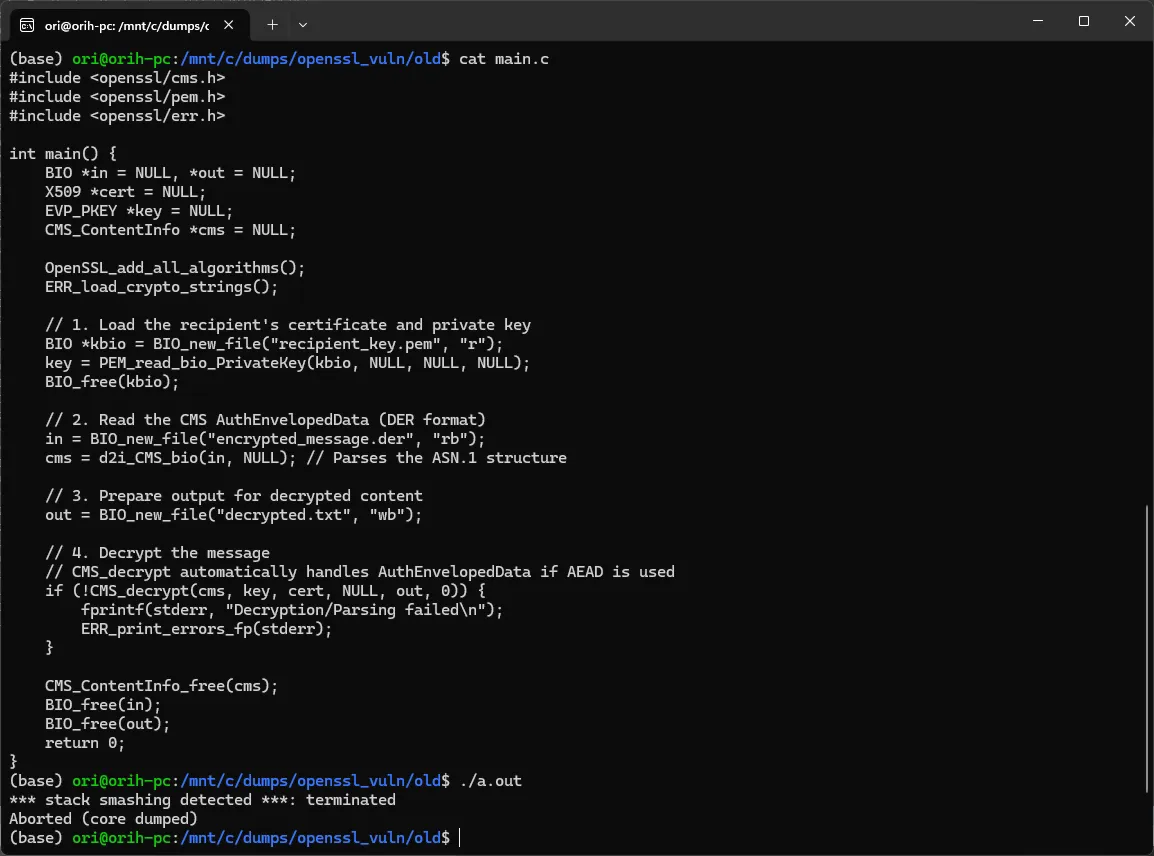
▪️CVE-2025-15467: Stack Buffer Overflow in CMS AuthEnvelopedData Parsing (High): A vulnerability with the potential to enable remote code execution under specific conditions
▪️CVE-2025-11187: PBMAC1 Parameter Validation in PKCS#12 (Moderate): Missing validation that could trigger a stack-based buffer overflow
Low Severity Flaws:
▪️CVE-2025-15468: Crash in QUIC protocol cipher handling
▪️CVE-2025-15469: Silent truncation bug affecting post-quantum signature algorithms (ML-DSA)
▪️CVE-2025-66199: Memory exhaustion via TLS 1.3 certificate compression
▪️CVE-2025-68160: Memory corruption in line-buffering (affects code back to OpenSSL 1.0.2)
▪️CVE-2025-69418: Encryption flaw in OCB mode on hardware-accelerated paths
▪️CVE-2025-69419: Memory corruption in PKCS#12 character encoding
▪️CVE-2025-69420: Crash in TimeStamp Response verification
▪️CVE-2025-69421: Crash in PKCS#12 decryption
▪️CVE-2026-22795: Crash in PKCS#12 parsing
▪️CVE-2026-22796: Crash in PKCS#7 signature verification (affects code back to OpenSSL 1.0.2)
When parsing CMS AuthEnvelopedData structures that use AEAD ciphers such as AES-GCM, the IV (Initialization Vector) encoded in the ASN.1 parameters is copied into a fixed-size stack buffer without verifying that its length fits the destination. An attacker can supply a crafted CMS message with an oversized IV, causing a stack-based out-of-bounds write before any authentication or tag verification occurs.
Applications and services that parse untrusted CMS or PKCS#7 content using AEAD ciphers (e.g., S/MIME AuthEnvelopedData with AES-GCM) are vulnerable. Because the overflow occurs prior to authentication, no valid key material is required to trigger it. While exploitability to remote code execution depends on platform and toolchain mitigations, the stack-based write primitive represents a severe risk.
Writeup: https://aisle.com/blog/aisle-discovered-12-out-of-12-openssl-vulnerabilities